Nathan Kaiser is Seattle entrepreneur who interviews Internet entrepreneurs for his website, nPost.com. It's a great place to catch up on interviews with young, cutting-edge entrepreneurs and study how they think and act. Tremendous insights to be gained.
Consider these comments from Leonard Brody, the Vancouver-based CEO and Founder of NowPublic. He does one of the best jobs I've seen in explaining how an entrepreneur's life differs from that of a standard corporate manager/employee.
"This is my fifth company. Frankly, there's no divine inspirational moment. I'm just a bad employee. I don't answer to people particularly well and I tend to be a much higher level thinker so where my thoughts are typically fifty thousand feet in the air, it's very difficult I think, when you're working in a larger organization to be creative.
"... Twelve years after starting my first company I realized that have a job is quite luxurious. You show up there's a desk and a phone. There's lunch. You don't have to worry about who is keeping the lights on. You do your job, you work and typically you go home and the stresses of work, while you may carry little bits of task-related things you have to do, the overall direction and strategy and vision is not really in your hands. There is an element of peace of mind you've got that you wouldn't have if you were an entrepreneur.
"The luxury that you trade off for that is having to deal with other people's politics and the organizational problems. It is an intense ride being an entrepreneur. I think most people underestimate that. I think they think it's the easiest thing in the world. It's a wonderful thing to work for yourself and there's no stress. Stress is ten times what it would be in the workforce, but I wouldn't have it any other way."
Read the complete interview here.
Tuesday, 26 September 2006

Wednesday, 13 September 2006
What do entrepreneurs want? Help.
Dave Free thought he had a service that marketing-oriented business owners would kill for: "an inexpensive, do-it-yourself system to collect customer feedback, generate referrals and stay in touch with their customers." It was a way to ensure their customers are happy and get them talking to their friends. And according to Free, testing showed users received substantial benefits, at low cost.
Funny thing, though. "As we've met with business owners in person or attracted them to our website, it has become clear that most of them don't want to be taught how to use the tool. They don't have time. They would much prefer to pay for a service."
Like many marketers before him, Free overestimated business owners' interest in learning new processes - even if it helps them save money. Time is their most precious commodity - and on their endless list of things to do, learning to use your service ranks, oh, somewhere about nowhere.
The ironically-named Free is now revamping his pricing model to cover the additional service his company must provide. "Some small businesses may balk, but I am now convinced that there are more small businesses looking for a fillet on the platter (complete with a wedge of lemon) than those interested in buying a fishing pole--even if it comes with a fly-tying kit."
Very interesting post from the front lines of small business marketing. Read the whole post here.
(Thanks to Dean Jones for the heads-up.)
Funny thing, though. "As we've met with business owners in person or attracted them to our website, it has become clear that most of them don't want to be taught how to use the tool. They don't have time. They would much prefer to pay for a service."
Like many marketers before him, Free overestimated business owners' interest in learning new processes - even if it helps them save money. Time is their most precious commodity - and on their endless list of things to do, learning to use your service ranks, oh, somewhere about nowhere.
The ironically-named Free is now revamping his pricing model to cover the additional service his company must provide. "Some small businesses may balk, but I am now convinced that there are more small businesses looking for a fillet on the platter (complete with a wedge of lemon) than those interested in buying a fishing pole--even if it comes with a fly-tying kit."
Very interesting post from the front lines of small business marketing. Read the whole post here.
(Thanks to Dean Jones for the heads-up.)
Friday, 8 September 2006
Keep it Simple!
I had a fascinating discussion today with a very frustrated vendor who targets small business.
They have a complex but very useful robust service for small business, and it’s very well priced. I can't imagine any business not getting its money’s worth, and much more, from their product.
Unfortunately, the prospects aren’t buying. Even though these services have been carefully targeted to the real needs of small business , the business owners remain skeptical and uninvolved.
I can't say much more due to client confidentiality, but I think there are three problems here, all of which are commonly encountered in selling to small business.
1) The client is trying to do too much. Its offer is bold and feature-rich. It’s like a VCR with too many buttons; I think the average entrepreneur has trouble taking it all in at first glance. And as we’ve said in this space before, even the best offers rarely get a second glance.
2) The client is trying to change behaviors. To take advantage of these services, most small business owners will have to change the way they view many of the functions they normally do. They’ll have to accept new, more sophisticated processes. While most of them need to make these changes, marketers (especially to small business) should never underestimate the difficulty of change.
3) The client is moving too fast. They need to start small and win the market’s trust before they can expect to sell complex integrated services. The solutions they're selling are valid, but they're not on the prospects’ priority list just yet. Keep it simple: Getting a few early wins would go a long way toward creating value for their prospects and thus build the trust needed to move them to the next level.
Entrepreneurs are no dummies. They know successful change is hard to achieve. Unless you make your offer bite-size and (relatively) risk-free, they're likely to take a pass.
That may be a mistake in the long run. But most entrepreneurs have enough on their plate dealing with short-term problems to worry about the long run.
They have a complex but very useful robust service for small business, and it’s very well priced. I can't imagine any business not getting its money’s worth, and much more, from their product.
Unfortunately, the prospects aren’t buying. Even though these services have been carefully targeted to the real needs of small business , the business owners remain skeptical and uninvolved.
I can't say much more due to client confidentiality, but I think there are three problems here, all of which are commonly encountered in selling to small business.
1) The client is trying to do too much. Its offer is bold and feature-rich. It’s like a VCR with too many buttons; I think the average entrepreneur has trouble taking it all in at first glance. And as we’ve said in this space before, even the best offers rarely get a second glance.
2) The client is trying to change behaviors. To take advantage of these services, most small business owners will have to change the way they view many of the functions they normally do. They’ll have to accept new, more sophisticated processes. While most of them need to make these changes, marketers (especially to small business) should never underestimate the difficulty of change.
3) The client is moving too fast. They need to start small and win the market’s trust before they can expect to sell complex integrated services. The solutions they're selling are valid, but they're not on the prospects’ priority list just yet. Keep it simple: Getting a few early wins would go a long way toward creating value for their prospects and thus build the trust needed to move them to the next level.
Entrepreneurs are no dummies. They know successful change is hard to achieve. Unless you make your offer bite-size and (relatively) risk-free, they're likely to take a pass.
That may be a mistake in the long run. But most entrepreneurs have enough on their plate dealing with short-term problems to worry about the long run.
Tuesday, 22 August 2006
How are entrepreneurs changing society?
Thinking about this subject on the dock at the cottage this weekend, I came come up with a list of five Canadian entrepreneurs who are changing society today.
In no particular order:
* Former eBay president Jeff Skoll was an early shareholder and the first employee of the online auction giant. Not only did the Montreal-born engineer help change the way the world buys and sells, but his Jeff Skoll Foundation now seeds social-entrepreneurship projects around the world, giving low-income societies the tools and motivation to help themselves.
* Energy Savings Income Fund is probably the largest business in Canada ever founded, built and owned by a woman. Rebecca MacDonald has sweated bullets and survived infuriating government policy reversals to give consumers a new way to save money on utility costs – and provide an exciting new role model for Canadian women.
* Jimmy Pattison, the former Vancouver car dealer, runs a mammoth personal empire that’s involved in advertising and publishing, supermarkets, real estate, transportation distribution – and still owns more than a dozen auto dealerships. It’s Canada’s third largest private corporation, and he says he’s not leaving it to his children – so I suspect he may emerge as one of Canada’s largest philanthropists.
Best of all, when Vancouver’s Expo86 went off the rails more than 20 years ago, Pattison took more than a year away from his business to whip it into shape. At a crucial time, Jimmy Pattison bailed out Canada
* Mike Lazaridis combined his boyhood love of radio and computers and developed the always-on wireless email device now known as the BlackBerry. He’s had a lot of help from his co-CEO, but it was Lazaridis' vision and curiosity that created Research in Motion and changed the way business communicates.
* Moving from BlackBerries to cranberries, there's Martin Le Moine, founder of Quebec-based Fruit d'Or, North America's first large-scale organic cranberry producer. Developed out of a hobby farm intended for Le Moine’s “retirement,” Fruit d'Or supplies dried and frozen cranberries and blueberries to food processors for use in trail mixes, drinks, cereals, granola and nutrition bars. He’s leading awareness of the health benefits of cranberries, and creating jobs in rural areas that need all the employment they can get. "I wanted to do something good," he told PROFIT Magazine this spring when Fruit d’Or was named Canada’s third fastest-growing company, "not just grow cranberries for the sake of growing cranberries."
Why do entrepreneurs matter? They're building Canada’s 21st century economy, they're changing lives and doing good. And their impact has never been greater.
In no particular order:
* Former eBay president Jeff Skoll was an early shareholder and the first employee of the online auction giant. Not only did the Montreal-born engineer help change the way the world buys and sells, but his Jeff Skoll Foundation now seeds social-entrepreneurship projects around the world, giving low-income societies the tools and motivation to help themselves.
* Energy Savings Income Fund is probably the largest business in Canada ever founded, built and owned by a woman. Rebecca MacDonald has sweated bullets and survived infuriating government policy reversals to give consumers a new way to save money on utility costs – and provide an exciting new role model for Canadian women.
* Jimmy Pattison, the former Vancouver car dealer, runs a mammoth personal empire that’s involved in advertising and publishing, supermarkets, real estate, transportation distribution – and still owns more than a dozen auto dealerships. It’s Canada’s third largest private corporation, and he says he’s not leaving it to his children – so I suspect he may emerge as one of Canada’s largest philanthropists.
Best of all, when Vancouver’s Expo86 went off the rails more than 20 years ago, Pattison took more than a year away from his business to whip it into shape. At a crucial time, Jimmy Pattison bailed out Canada
* Mike Lazaridis combined his boyhood love of radio and computers and developed the always-on wireless email device now known as the BlackBerry. He’s had a lot of help from his co-CEO, but it was Lazaridis' vision and curiosity that created Research in Motion and changed the way business communicates.
* Moving from BlackBerries to cranberries, there's Martin Le Moine, founder of Quebec-based Fruit d'Or, North America's first large-scale organic cranberry producer. Developed out of a hobby farm intended for Le Moine’s “retirement,” Fruit d'Or supplies dried and frozen cranberries and blueberries to food processors for use in trail mixes, drinks, cereals, granola and nutrition bars. He’s leading awareness of the health benefits of cranberries, and creating jobs in rural areas that need all the employment they can get. "I wanted to do something good," he told PROFIT Magazine this spring when Fruit d’Or was named Canada’s third fastest-growing company, "not just grow cranberries for the sake of growing cranberries."
Why do entrepreneurs matter? They're building Canada’s 21st century economy, they're changing lives and doing good. And their impact has never been greater.
Friday, 11 August 2006
What is an Entrepreneur?
"An entrepreneur is not necessarily a risk taker, but a risk reducer. Each day at work, the entrepreneur seeks to make decisions to increase the longevity of the business and diminish the risk.
"And yet, herein lies a paradox. For an entrepreneur, lack of growth (and uncertainty) is like death. When things start becoming too predictable, the challenge ebbs away. It is then time for a new dream, a new vision."
Rajesh Jain (founder of India's first portal and its first web services company).
"An entrepreneur to me just means someone who thinks out of the box and they’re on a different beam. 1 + 1 doesn’t equal 2. 1 + 1 equals 5 to them, somehow.”
Michael Crooke, President & CEO, Patagonia, Inc.
"And yet, herein lies a paradox. For an entrepreneur, lack of growth (and uncertainty) is like death. When things start becoming too predictable, the challenge ebbs away. It is then time for a new dream, a new vision."
Rajesh Jain (founder of India's first portal and its first web services company).
"An entrepreneur to me just means someone who thinks out of the box and they’re on a different beam. 1 + 1 doesn’t equal 2. 1 + 1 equals 5 to them, somehow.”
Michael Crooke, President & CEO, Patagonia, Inc.
Wednesday, 2 August 2006
No humor please, we're business owners

I saw this piece of direct mail today from Bell promoting their Sympatico High Speed Unplugged Internet Service. It's not directly targeted at CEOs and entrepreneurs, but at travellers who will pay $45 a month (and up) to connect to the Net from offices, homes and airport lounges across the country.
Which means business owners are a big part of the target market.
In my previous post (below or here), when I advised marketers to "use humour sparingly," I wasn't thinking of animated beavers specifically. But I should have been.
To paraphrase and repeat: When marketing to CEOs, no cartoon beavers.
Monday, 31 July 2006
How to reach the CEO
I was talking recently with a prospective client who was keen to target CEOs. And while I tend to think of myself as the “entrepreneur” guy, in truth, I have been writing for CEOs for 25 years.
Not only the CEOs of entrepreneurial companies, but of big businesses as well. My education in journalism came at the Financial Times of Canada, the weekly business tabloid that aimed at top corporate decision-makers.
In six years I went from temporary summer replacement to managing editor (the guy who runs the newsroom). The reason? With a lot of patient coaching from terrific editors such as David Tafler, Paul Nowack, T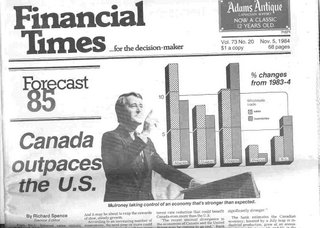 erry Corcoran and Ron Blunn, I figured out what it takes to engage the CEO.
Here’s what I had pounded into my head every week about catching the attention of CEOs:
* Offer them an advantage. Call it a benefit if you must, but these are competitive people. They prefer solutions that do more than just help them – they want products, services and information that put them ahead of the other guys.
* Keep it relevant. You have to be as focused as they are. As soon as you appear to wander or go off track, CEOs will turn the page, change the channel, or start looking at their watch.
* Be timely. When they need you, they need you now. If you get to them a day late, you've lost the sale.
* Be specific. Don’t just say your solution can boost the bottom line. Explain quickly and exactly what your product or service does and how it will help them.
* Use clear and simple examples. Don’t expect them to connect the dots for you or reach the conclusion you want. Spell it out.
* Use humour sparingly. If they don't find it funny, they’ll think you're wasting their time. And there’s no worse sin than that.
(Click here for my tribute to Ron Blunn, one of my editors at the Times, who passed away in June at the age of 56.)
Not only the CEOs of entrepreneurial companies, but of big businesses as well. My education in journalism came at the Financial Times of Canada, the weekly business tabloid that aimed at top corporate decision-makers.
In six years I went from temporary summer replacement to managing editor (the guy who runs the newsroom). The reason? With a lot of patient coaching from terrific editors such as David Tafler, Paul Nowack, T
 erry Corcoran and Ron Blunn, I figured out what it takes to engage the CEO.
Here’s what I had pounded into my head every week about catching the attention of CEOs:
* Offer them an advantage. Call it a benefit if you must, but these are competitive people. They prefer solutions that do more than just help them – they want products, services and information that put them ahead of the other guys.
* Keep it relevant. You have to be as focused as they are. As soon as you appear to wander or go off track, CEOs will turn the page, change the channel, or start looking at their watch.
* Be timely. When they need you, they need you now. If you get to them a day late, you've lost the sale.
* Be specific. Don’t just say your solution can boost the bottom line. Explain quickly and exactly what your product or service does and how it will help them.
* Use clear and simple examples. Don’t expect them to connect the dots for you or reach the conclusion you want. Spell it out.
* Use humour sparingly. If they don't find it funny, they’ll think you're wasting their time. And there’s no worse sin than that.
(Click here for my tribute to Ron Blunn, one of my editors at the Times, who passed away in June at the age of 56.)
Subscribe to:
Posts (Atom)